

All Real Numbers On Graph
How to Classify Real Numbers
The "stack of funnels" diagram below will aid u.s. easily classify whatever existent numbers. Simply first, nosotros need to describe what kinds of elements are included in each grouping of numbers. A funnel represents each group or set of numbers.
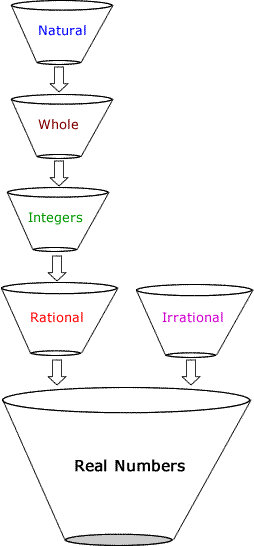
Description of Each Set of Real Numbers

Natural numbers (besides known as counting numbers) are the numbers that we utilize to count. It begins with 1, so 2, 3, and so on.


Whole numbers are a slight "upgrade" of the natural numbers considering nosotros simply add the element naught to the current ready of natural numbers. Think of whole numbers as natural numbers together with zero.


Integers include all whole numbers together with the "negatives" or opposites of the natural numbers.


Rational numbers are numbers that tin exist expressed as a ratio of integers. That means if we tin can write a given number as a fraction where the numerator and denominator are both integers; then it is a rational number.
Symbolically, we can write a rational number as:

Caution: The denominator cannot equal goose egg.
Rational numbers can also appear in decimal form. If the decimal number either terminates or repeats, so it is possible to write it as a fraction with an integer numerator and denominator. Thus, information technology is rational too.

Irrational numbers are all numbers that when written in decimal form do not repeat and do non terminate. In other words, information technology goes on forever indefinitely without having a definite pattern.

Real numbers include both rational and irrational numbers. Remember that under the set up of rational numbers, we have the subcategories or subsets of integers, whole numbers, and natural numbers.
Classification of Real Numbers Examples
Example ane: A natural number is also a whole number. (True or Imitation)
The set of whole numbers includes the number zero and all natural numbers. This is a truthful argument.
Example 2: An integer is always a whole number. (True or Simulated)
The set of integers is equanimous of the number naught, natural numbers, and the "negatives" of natural numbers. That ways some integers are whole numbers, but not all.
For instance, - 2 is an integer but not a whole number. This statement is false.
Example 3: Every rational number is as well an integer. (True or Imitation)
The give-and-take "every" means "all". Tin you think of a rational number that is non an integer? You only need one counterexample to show that this statement is false.
The fraction \Large{1 \over ii} is an example of a rational number that is NOT an integer. And then this statement is false.
Example 4: Every integer is a rational number. (Truthful or False)
This is true because every integer tin exist written as a fraction with a denominator of 1.
Example 5: Every natural number is a whole number, integer, and a rational number. (True or Fake)
Reviewing the descriptions above, natural numbers are found within the sets of whole numbers, integers, and rational numbers. That makes it a true statement.
We can also use the diagram of funnels in a higher place to help u.s. answer this question. If we pour h2o into the "funnel of natural numbers", the water should also period through all the funnels beneath it. Thus, passing through the funnels of the whole numbers, integers, and rational numbers.
Case 6: Every whole number is a natural number, integer, and rational number. (True or Simulated)
Using the same "funnel" analogy; if we pour some liquid into the whole numbers' funnel, it should laissez passer through the funnels of integers and rational numbers as it makes its mode downwards. Since the natural numbers' funnel is to a higher place the set of whole numbers where nosotros started, we cannot include this funnel in the group.
Information technology is a false statement since whole numbers belong to the sets of integers and rational numbers, merely not to the fix of natural numbers.
Simply put, the number zero (0) is a counterexample since it is a whole number simply not a natural number. Then indeed, this is a false statement.
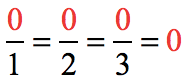
Example vii: Classify the number zero, 0.
Definitely not a natural number but information technology is a whole, an integer, a rational, and a existent number. Information technology may not be obvious that zero is also a rational number. Nonetheless, writing it equally a fraction with a nonzero denominator would conspicuously show that it is indeed
Example 8: Classify the number five.
This is a natural or counting number, a whole number, and an integer. Since we can write information technology as a fraction with a denominator of 1, that is, \Large{v \over 1}, it is also a rational number. And of course, this is a real number.
Example ix: Allocate the number 0.25.
The given decimal number terminates and and so we tin write it every bit a fraction which is a characteristic of a rational number. This number is too a existent number.
\Large{0.25 = {{25} \over {100}} = {1 \over 4}}
Instance x: Classify the number {\rm{2}}{1 \over 5}.
We tin can rewrite this mixed fraction every bit an improper fraction so that it is clear that we accept a ratio of two integers.
\Large{{\rm{two}}{1 \over five} = {{xi} \over v}}
This number is a rational and real number.
Example 11: Classify the number {\rm{five.241879132…}}.
The decimal number is non-terminating and non-repeating that means it is an irrational number. Of course, any irrational number is also a real number.
Case 12: Classify the number ane.7777…
Since the decimal is repeating, information technology is a rational number. Any rational number must also be a existent number.
Example 13: Classify the number \sqrt 2 .
This is an irrational number because when written in decimal form, it is non-terminating and non-repeating. This is also a existent number.
Case xiv: Classify the number - \sqrt {xvi} .
Offset, we need to simplify this radical expression which gives us - \sqrt {16} = - \,4. The number - \,4 is an integer, a rational number, and a existent number.
Example fifteen: Classify the number - 8.123123….
The decimal number is nonterminating, however, the string of numbers 123 after the decimal bespeak keeps on repeating. We can rewrite the decimal number with a "bar" on top of the repeating numbers.

This makes it a rational number. Don't forget that it is also a real number.
You might also be interested in:
Properties of Real Numbers
Properties of Equality

All Real Numbers On Graph,
Source: https://www.chilimath.com/lessons/introductory-algebra/classifying-real-numbers/
Posted by: palmerwastual.blogspot.com
0 Response to "All Real Numbers On Graph"
Post a Comment