

China Spheres Of Influence Map

In the field of international relations, a sphere of influence (SOI) is a spatial region or concept division over which a state or organisation has a level of cultural, economic, military machine or political exclusivity.[ commendation needed ]
While in that location may be a formal alliance or other treaty obligations between the influenced and influencer, such formal arrangements are not necessary and the influence can oftentimes be more of an example of soft power. Similarly, a formal brotherhood does not necessarily mean that ane country lies inside another's sphere of influence. Loftier levels of exclusivity take historically been associated with higher levels of conflict.
In more extreme cases, a state within the "sphere of influence" of another may become a subsidiary of that state and serve in effect as a satellite country or de facto colony. This was the instance with the Soviet Union and its Eastern Bloc after World War II. The arrangement of spheres of influence past which powerful nations intervene in the diplomacy of others continues to the nowadays. It is often analyzed in terms of superpowers, slap-up powers, and/or eye powers.
Sometimes portions of a unmarried country can autumn into ii distinct spheres of influence. In the 19th century, the buffer states of Iran and Thailand, lying betwixt the empires of Britain, France and Russia, were divided between the spheres of influence of those 3 international powers. Likewise, after Earth State of war II, Germany was divided into four occupation zones, 3 of which later consolidated into West Federal republic of germany and the remaining i became East Frg, the sometime a member of NATO and the latter a member of the Warsaw Pact.
The term is also used to describe non-political situations, e.thou., a shopping mall is said to accept a 'sphere of influence' that designates the geographical area where it dominates the retail merchandise.[ citation needed ]
Historical remnants [edit]
Many powerful states in past centuries had subordinate tributary states, whose native dynasty acknowledged the suzerainty of the great power.

Map of Africa in 1897 shows European "sphere[s] of influence".
Many areas of the world are joined by a cultural influence inherited from a previous sphere of influence, even if they are no longer under political control. Examples include Anglosphere, Arab World, Persosphere, Eurosphere, Francophonie, Françafrique, Germanosphere, Indosphere, Hispanidad, Latin Europe/Latin America, Lusophonie, Turkosphere, Sinosphere, Slavisphere, Malay world, Post-Soviet States and many others.
Early on United States (1820s) [edit]
Alexander Hamilton, showtime U.S. Secretary of the Treasury, aimed for the United States to establish a sphere of influence in North America.[ane] Hamilton, writing in the Federalist Papers, harboured ambitions for the The states to rise to world power condition and proceeds the strength to expel European powers from the Americas, taking on the curtain of regional dominance among American nations, although most of the New World were European colonies during that menstruation.[two]
This doctrine, dubbed the 'Monroe Doctrine', was formalized under President James Monroe, who asserted that the New World was to be established as a Sphere of influence, removed from European inroad. As the U.S. emerged as a globe power, few nations dared to trespass on this sphere.[3] (A notable exception occurred with the Soviet Union and the Cuban Missile Crisis.)
As of 2018, Secretarial assistant of State King Tillerson continued to refer to the Monroe Doctrine to tout the United States as the region'due south preferred trade partner over other nations such equally China.[4]
New Imperialism era (late 1800s–early 1900s) [edit]

Delimitation of British and Russian influence in Iran
For Siam (Thailand), Great britain and France signed an agreement in 1904 whereby the British recognised a French sphere of influence to the east of the River Menam'south (Chao Phraya River) basin; in turn, the French recognised British influence over the territory to the west of the Menam basin and west of the Gulf of Thailand. Both parties disclaimed whatever idea of annexing Siamese territory.[5]
In the Anglo-Russian Convention of 1907, Britain and Russian federation divided Persia (Iran) into spheres of influence, with the Russians gaining recognition for influence over most of northern Iran, and U.k. establishing a zone in the Southeast.[6] [7]
China [edit]
In China, during the late 19th and early 20th centuries (known in China as the "century of humiliation"), Britain, France, Germany, Russian federation, and Nihon held special powers over large swaths of Chinese territory based on securing "nonalienation commitments" for their "spheres of involvement"; only the United States was unable to participate due to their interest in the Spanish–American State of war. These spheres of influence were acquired by forcing the Qing government to sign "unequal treaties" and long-term leases.[eight]
In early 1895, the French laid claim to a sphere in Southwest Communist china.[9] Past December 1897, High german Kaiser Wilhelm 2 declared his intent to seize territory in Mainland china, precipitating the scramble to demarcate zones of influence in Cathay. The Germans acquired, in Shandong province, exclusive control over developmental loans, mining, and railway buying,[10] while Russia gained a sphere over all territory n of the Bully Wall,[11] in addition to the previous tax exemption for trade in Mongolia and Xinjiang,[12] economic powers similar to Germany'due south over Fengtian, Jilin, and Heilongjiang provinces. France gained a sphere over Yunnan, too as most of Guangxi and Guangdong provinces;[13] Japan over Fujian province;[13] and the British over the whole Yangtze River valley[thirteen] (defined as all provinces bordering the Yangtze river too equally Henan and Zhejiang provinces),[11] parts of Guangdong and Guangxi provinces,[14] and role of Tibet.[15] Only Italia's asking for Zhejiang province was declined past the Chinese government.[thirteen] These practise not include the charter and concession territories where the foreign powers had total authorization.

Spheres of influence in Chinese empire in early on 20th century
The Russian government militarily occupied their zone, imposed their law and schools, seized mining and logging privileges, settled their citizens, and even established their municipal administration on several cities,[16] the latter without Chinese consent.[17]
The powers (and the United States) might have their own courts, post offices, commercial institutions, railroads, and gunboats in what was on paper Chinese territory. Still, the foreign powers and their control in some cases could have been exaggerated; the local government persistently restricted further encroachment.[18] The organisation concluded afterward the 2nd Globe War.
On September 6, 1899, U.S. Secretary of Land John Hay sent notes to the major powers (France, Germany, Uk, Italy, Japan, and Russian federation), asking them to declare formally that they would uphold Chinese territorial and administrative integrity and would not interfere with the free use of the treaty ports within their spheres of influence in Mainland china, as the United States felt threatened by other powers' much larger spheres of influence in China and worried that it might lose admission to the Chinese market should the state exist officially partitioned.[nineteen] Although treaties made after 1900 refer to this "Open Door Policy", contest among the diverse powers for special concessions within China for railroad rights, mining rights, loans, strange trade ports, and so forth, connected unabated,[twenty] with the US itself contradicting the policy by agreeing to recognise the Japanese sphere in the Lansing-Ishii Agreement.[21]
In 1910, the great powers, U.k., French republic, Deutschland, United States, and subsequently, Russia and Japan, ignored the Open Door Policy to form a banking consortium, consisting of national banking groups backed by respective governments, through which all foreign loans to China were monopolised, granting the powers political influence over China and reducing economical competition betwixt foreigners. This system controlled the bulk of Chinese taxation revenue in a "trust", utilising a small-scale portion to bolster the dominion of Chinese warlord Yuan Shikai to great issue. The renewed consortium of UK, French republic, Nippon and the U.S. in 1920 effectively vetoed all developmental loans to China, exerting control over the Chinese government past aiming to command all railroads, ports and highways in China.[22] [23] The Consortium helped to incorporate the political and financial conflict between parties and states over the loans, while imposing foreign control on Red china's finances during the period of revolutionary upheaval, which the Consortium also helped to precipitate.[24]
World War 2 (1939–45) [edit]
Empire of Japan [edit]

German and Japanese direct spheres of influence at their greatest extents in autumn 1942.
For another instance, during the meridian of its existence in World War Ii, the Japanese Empire had quite a large sphere of influence. The Japanese government straight governed events in Korea, Vietnam, Taiwan, and parts of People's republic of china. The "Greater Eastward Asia Co-Prosperity Sphere" could thus be quite easily drawn on a map of the Pacific Ocean every bit a big "chimera" surrounding the islands of Nihon and the Asian and Pacific nations it controlled.[ citation needed ]
Molotov–Ribbentrop Pact [edit]
According to a secret protocol fastened to the Molotov–Ribbentrop Pact of 1939 (revealed merely subsequently Frg's defeat in 1945), Northern and Eastern Europe were divided into Nazi and Soviet spheres of influence:[25]
- In the north, Finland, Estonia, and Latvia were assigned to the Soviet sphere.[25]
- Poland was to be partitioned in the event of its "political rearrangement"—the areas due east of the Narev, Vistula, and San Rivers going to the Soviet Matrimony, while Germany would occupy the west.[25]
- Lithuania, adjacent to E Prussia, would exist in the German language sphere of influence, although a second secret protocol agreed in September 1939 assigned Lithuania to the USSR.[26]
Another clause of the treaty stipulated that Bessarabia, then part of Romania, would join the Moldovan ASSR and become the Moldovan SSR under the command of Moscow.[25] The Soviet invasion of Bukovina on 28 June 1940 violated the Molotov-Ribbentrop Pact, as it went beyond the Soviet sphere of influence as agreed with the Axis.[27] The USSR continued to deny the being of the Pact's protocols until after the dissolution of the Soviet Wedlock when the Russian government fully acknowledged the beingness and authenticity of the secret protocols.[28]
End of World War II [edit]
From 1941 and the German language attack on the Soviet Union, the Allied Coalition operated on the unwritten supposition that the Western Powers and the Soviet Union had each its own sphere of influence. The presumption of the Usa-British and Soviet unrestricted rights in their corresponding spheres began to crusade difficulties as the Nazi-controlled territory shrank and the allied powers successively liberated other states.[29]
The wartime spheres lacked a practical definition and it had never been adamant if a ascendant allied ability was entitled to unilateral decisions only in the area of military activity, or could too strength its will regarding political, social and economic future of other states. This overly informal system backfired during the belatedly stages of the war and after, when it turned out that the Soviets and the Western Allies had very different ideas concerning the administration and future development of the liberated regions and of Germany itself.[29]
Common cold War (1947–91) [edit]
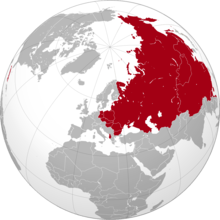
During the Common cold State of war, the Soviet sphere of influence was said to include: the Baltic states, Cardinal Europe, some countries in Eastern Europe, Republic of cuba, Lao people's democratic republic, Vietnam, Due north Korea, and—until the Sino-Soviet split and Tito–Stalin split—the Prc and the People's Federal Republic of Yugoslavia, amidst other countries at various times. Meanwhile, United States was considered to have a sphere of influence over Western Europe, Oceania, Nihon, and Republic of korea, amongst other places.[ commendation needed ]
Still, the level of command exerted in these spheres varied and was not accented. For example, France and the Britain were able to act independently to invade (with Israel) the Suez Canal (they were later forced to withdraw by joint U.Southward. and Soviet pressure). Later, France was likewise able to withdraw from the war machine arm of the North Atlantic Treaty Organisation (NATO). Cuba, as another example, often took positions that put it at odds with its Soviet ally, including momentary alliances with Cathay, economic reorganizations, and providing back up for insurgencies in Africa and the Americas without prior approval from the Soviet Spousal relationship.[ citation needed ]
With the end of the Cold War, the Eastern Bloc fell autonomously, finer catastrophe the Soviet sphere of influence. Then in 1991, the Soviet Matrimony ceased to be, replaced past the Russian Federation and several other ex-Soviet Republics who became independent states.
Contemporary Russia (1990s–nowadays) [edit]

Subsequently the fall of the Soviet Union, the countries of Eastern Europe, the Caucasus, and Central Asia that became contained were often portrayed as part of the Russian Federation's 'sphere of influence'. Co-ordinate to Ulrich Speck, writing for Carnegie Europe, "After the breakdown of the Soviet Union, the West's focus was on Russian federation. Western nations implicitly treated the postal service-Soviet countries (besides the Baltic states) as Russia'south sphere of influence."[xxx]
In 1997, NATO and Russia signed the Founding Act on Mutual Relations, Cooperation and Security, stating the "aim of creating in Europe a common space of security and stability, without dividing lines or spheres of influence limiting the sovereignty of any state."[31]
On August 31, 2008, Russian president Dmitri Medvedev stated v principles of foreign policy, including the merits of a privileged sphere of influence that comprised "the border region, just not only".[32] In 2009, Russia asserted that the European Wedlock desires a sphere of influence and that the Eastern Partnership is "an attempt to extend" it.[33] In March that year, Swedish Foreign Minister Carl Bildt stated that the "Eastern Partnership is not about spheres of influence. The difference is that these countries themselves opted to join."[33]
Post-obit the 2008 Russo-Georgian State of war, Václav Havel and other former key and eastern European leaders signed an open alphabetic character stating that Russia had "violated the core principles of the Helsinki Final Act, the Charter of Paris ... all in the proper noun of defending a sphere of influence on its borders."[34] In Apr 2014, NATO stated that, reverse to the Founding Human activity,
Russia now appears to be attempting to recreate a sphere of influence past seizing a part of Ukraine, maintaining big numbers of forces on its borders, and enervating, every bit Russian Foreign Government minister Sergei Lavrov recently stated, that "Ukraine cannot be part of any bloc."[35]
Criticising Russia in November 2014, German Chancellor Angela Merkel said that "one-time thinking about spheres of influence, which runs savage over international law" put the "unabridged European peace social club into question."[36] In January 2017, British Prime Minister Theresa May said, "Nosotros should non jeopardise the freedoms that President Reagan and Mrs Thatcher brought to Eastern Europe by accepting President Putin'due south claim that it is now in his sphere of influence."[37]
Corporations [edit]
In corporate terms, the sphere of influence of a business organisation, organization, or group can show its power and influence in the decisions of other businesses/organizations/groups. The influence shows in several ways, such as in size, frequency of visits, etc. In most cases, a company described equally "bigger" has a larger sphere of influence.
For example, the software company Microsoft has a large sphere of influence in the market of operating systems; whatsoever entity wishing to sell a software product may weigh upwards compatibility with Microsoft's products every bit part of a marketing plan.[ citation needed ] In another example, retailers wishing to make the near profits must ensure they open their stores in the right location. This is too true for shopping centers that, to reap the most profits, must be able to attract customers to their vicinity.[ citation needed ]
There is no defined scale measuring such spheres of influence. However, i can evaluate the spheres of influence of ii shopping centers past seeing how far people are prepared to travel to each shopping centre, how much time they spend in its vicinity, how often they visit, the society of appurtenances available, etc.[ commendation needed ]
Corporations have significant influence on the regulations and regulators that monitor them. During the Gilded Age in the United States, corruption was rampant every bit business leaders spent significant amounts of coin ensuring that government did non regulate their activities.[38] Wall Street spent a tape $2 billion trying to influence the 2016 U.s.a. elections.[39] [40]
List of spheres of influence [edit]
- Anglosphere — English-speaking world
- East Asian cultural sphere (aka Sinosphere) — historically Chinese-influenced cultures
- Eurosphere — area with European Spousal relationship influence
- Francosphere — French-speaking world
- Germanosphere — German-speaking world
- Greater East asia Co-Prosperity Sphere — regal influence of the Japanese Empire
- Indosphere — surface area with Indian linguistic and cultural influence (Greater India)
- Persophere — historically Iran-influenced cultures
- Islamosphere — the Muslim world
- Slavisphere — Slavic influence
- Soviet sphere of influence — imperial influence of the Soviet Wedlock
Other examples [edit]
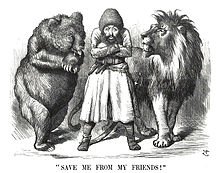
For historical and current examples of significant battles over spheres of influence come across:
- The Great Game
- Geostrategy in Central Asia
See besides [edit]
- Cultural area
- Geopolitics
- National involvement
- Balance of power in international relations
- Sprachbund
- Unequal treaty
- Informal empire
References [edit]
- ^ "Monroe Doctrine, 1823". Role of the Historian. United States Department of Land. April 6, 2016. Retrieved March 26, 2016.
- ^ Morison, S.E. (Feb 1924). "The Origins of the Monroe Doctrine". Economica. doi:10.2307/2547870. JSTOR 2547870.
- ^ New Encyclopædia Britannica. Vol. 8 (15th ed.). Encyclopædia Britannica. p. 269. ISBN1-59339-292-3.
- ^ Gramer, Robbie. "Tillerson Praises Monroe Doctrine, Warns Latin America of 'Imperial' Chinese Ambitions". Foreign Policy. The Slate Group.
- ^ . Governments of Great Uk and the France. 1904 – via Wikisource.
- ^ British Documents on the Origins of the State of war 1898-1914, Volume Four, The Anglo-Russian Rapprochement 1903-7. Edited by G.P. Gooch and H Temperley. Her Majesty'south Stationery Function, London 1929. p618-621. Appendix IV - Revised Draft of Agreement Concerning Persia, Sent to Sir A. Nicholson by Sir Edward Grey on June 6, 1907
- ^ Yale Police School: "Agreement apropos Persia" (in English)
- ^ Kwang-ching Liu; John Fairbank. The Cambridge History of People's republic of china Volume 11 Late Ch'ing 1800-1911 Part 2. Cambridge Academy Press. p. 113. ISBN0521220297.
- ^ Kwang-ching Liu; John Fairbank. The Cambridge History of People's republic of china Volume 11 Late Ch'ing 1800-1911 Part 2. Cambridge Academy Press. p. 274. ISBN0521220297.
- ^ Jeans, Roger B. (1997). Democracy and Socialism in Republican People's republic of china: The Politics of Zhang Junmai (Carsun Chang), 1906-1941. Rowman & Littlefield. p. 28. ISBN0847687074.
- ^ a b Dallin, David J. (2013). "two The Second Drive to the Pacific, Section Port Arthur". The Rise Of Russia In Asia. Read Books Ltd. ISBN978-1473382572.
- ^ Paine, S. C. M. (1996). "Chinese Affairs in Disarray: The Treaty of Livadia". Imperial Rivals: Prc, Russia, and Their Disputed Frontier . Thousand.East. Sharpe. pp. 162. ISBN9781563247248 . Retrieved 22 February 2018.
- ^ a b c d Lo Jiu-Hwa, Upshur (2008). Encyclopedia of Earth History, Ackerman-Schroeder-Terry-Hwa Lo, 2008: Encyclopedia of Earth History Volume 7 of Encyclopedia of World History. Fact on File Publishing, Inc Bukupedia. pp. 87–88.
- ^ Wu Yuzhang (2001). Recollections of the Revolution of 1911: A Dandy Democratic Revolution of Mainland china. The Minerva Group, Inc. p. 39. ISBN089875531X.
- ^ Convention Betwixt Bully United kingdom and Tibet (1904)
- ^ Shan, Patrick Fuliang (2003). The Development of the Due north Manchuria Frontier, 1900-1931. Hamilton, Ontario: McMaster University. p. 13.
- ^ Shan, Patrick Fuliang (2016). Taming China's Wilderness: Immigration, Settlement and the Shaping of the Heilongjiang Borderland, 1900-1931. Routledge. p. 154. ISBN978-1317046844.
- ^ Patrick Fuliang Shan, "What was the 'Sphere of Influence'? A Study of Chinese Resistance to the Russian Empire in North Manchuria, 1900-1917," The Chinese Historical Review, (Autumn 2006, vol. 13, no. 2), pp.271-291.
- ^ "Secretary of State John Hay and the Open up Door in Prc, 1899–1900". Milestones: 1899–1913. Office of the Historian, The states Department of State. Retrieved 17 Jan 2014.
- ^ Sugita, Yoneyuki, "The Rise of an American Principle in Prc: A Reinterpretation of the First Open Door Notes toward China" in Richard J. Jensen, Jon Thares Davidann, and Yoneyuki Sugita, eds. Trans-Pacific relations: America, Europe, and Asia in the twentieth century (Greenwood, 2003) pp 3–20 online
- ^ Tuchman, Barbara (2001). Stillwell and the American Experience in People's republic of china 1911-1945. Grove Press. p. 48. ISBN0-8021-3852-7.
- ^ Werner Levi (1953). Modern Mainland china's Foreign Policy. U of Minnesota Press. pp. 123–132. ISBN081665817X.
- ^ B. J. C. McKercher (1991). Anglo-American Relations in the 1920s: The Struggle for Supremacy. Springer. p. 166. ISBN1349119199.
- ^ Davis, Clarence B. "Financing Imperialism: British and American Bankers as Vectors of Imperial Expansion in Cathay, 1908-1920." The Business organisation History Review 56, no. 2 (1982): 236–64. https://doi.org/ten.2307/3113978.
- ^ a b c d Text of the Nazi-Soviet Non-Aggression Pact, executed August 23, 1939
- ^ Christie, Kenneth, Historical Injustice and Democratic Transition in Eastern asia and Northern Europe: Ghosts at the Table of Democracy, RoutledgeCurzon, 2002, ISBN 0-7007-1599-ane
- ^ Brackman, Roman, The Clandestine File of Joseph Stalin: A Hidden Life (2001) p. 341
- ^ Etkind, Alexander; Finnin, Rory; Blacker, Uilleam; Julie Fedor; Simon Lewis; Maria Mälksoo; Matilda Mroz (2013). Remembering Katyn. John Wiley & Sons. ISBN978-0-7456-6296-ane.
- ^ a b Norman Davies, Europe at War 1939–1945: No Uncomplicated Victory, pp. 172-174. Penguin Books, New York 2006, ISBN 978-0-14-311409-3
- ^ Speck, Ulrich (nine Dec 2014). "The European union Must Set up for a Common cold Peace With Russia". Carnegie Europe.
- ^ "Founding Act on Common Relations, Cooperation and Security between NATO and the Russia signed in Paris, France". NATO. 27 May 1997.
- ^ Kramer, Andrew E. (2008-09-01). "Russian federation Claims Its Sphere of Influence in the World". The New York Times. ISSN 0362-4331. Retrieved 2021-08-31 .
- ^ a b Pop, Valentina (21 March 2009). "Eu expanding its 'sphere of influence,' Russia says". EUObserver.
- ^ Valdas Adamkus, Martin Bútora, Emil Constantinescu, Pavol Demeš, Luboš Dobrovský, Mátyás Eörsi, István Gyarmati, Václav Havel, Rastislav Káčer, Sandra Kalniete, Karel Schwarzenberg, Michal Kováč, Ivan Krastev, Aleksander Kwaśniewski, Mart Laar, Kadri Liik, János Martonyi, Janusz Onyszkiewicz, Adam Daniel Rotfeld, Vaira Vīķe-Freiberga, Alexandr Vondra, Lech Wałęsa (xv July 2009). "An Open Letter to the Obama Administration from Primal and Eastern Europe". Gazeta Wyborcza.
{{cite web}}: CS1 maint: uses authors parameter (link)- "An Open Letter". Radio Costless Europe.
- ^ "Russia'due south accusations - setting the record directly, Fact Canvas - Apr 2014". NATO. 12 May 2014.
- ^ Rettman, Andrew (17 November 2014). "Merkel: Russia cannot veto EU expansion". EUobserver.
- ^ "FULL TEXT: Theresa May'south speech to the Republican 'Congress of Tomorrow' conference". Business Insider. 26 January 2017. Archived from the original on 27 Jan 2017.
- ^ Tindall, George Brown; Shi, David E. (2012). America: A Narrative History. Vol. ii (Brief Ninth ed.). West. W. Norton. p. 578.
- ^ "Wall Street spends tape $2bn on US election lobbying". Fiscal Times. March 8, 2017.
- ^ "Wall Street Spent $two Billion Trying to Influence the 2016 Election". Fortune. March 8, 2017.
Farther reading [edit]
- Ferguson, Iain, and Susanna Hast. 2018. "Introduction: The Return of Spheres of Influence? [PDF]" Geopolitics 23(2):277-84. doi:ten.1080/14650045.2018.1461335.
- Hast, Susanna. 2016. Spheres of Influence in International Relations: History, Theory and Politics. Milton Park, Great britain: Routledge.
- Icenhower, Brian. 2018. "SOI: Building a Real Estate Agent'south Sphere of Influence." CreateSpace Contained Publishing Platform.
- Piffanelli, Luciano. 2018. "Crossing Boundaries: A Problem of Territoriality in Renaissance Italian republic", Viator. Medieval and Renaissance Studies, 49(three):245-275.
- White, Craig Howard. 1992. Sphere of Influence, Star of Empire: American Renaissance Cosmos, Vol. 1. Madison: Academy of Wisconsin-Madison.
External links [edit]
- The CommonCensus Map Project – Calculates the spheres of influence for American cities based on voting
- Russian federation - a counterbalancing agent to the Asia.

China Spheres Of Influence Map,
Source: https://en.wikipedia.org/wiki/Sphere_of_influence
Posted by: palmerwastual.blogspot.com
0 Response to "China Spheres Of Influence Map"
Post a Comment